Table of Contents
- Key Takeaways
- Quick Verdict
- Product Overview & Specifications
- Real-World Performance & Feature Analysis
- Design & Build Quality: Where the Price Justifies Itself
- Performance in Real Use: Two Dogs, Two Very Different Experiences
- Ease of Cleaning: The Trade-Off for Better Materials
- Durability & Long-Term Reliability
- Pros & Cons
- Comparison & Alternatives
- Buying Guide / Who Should Buy
- Frequently Asked Questions
If you’ve ever watched your dog inhale their food like a vacuum cleaner, you know the panic that sets in. The choking sounds, the immediate regurgitation, the worried looks—it’s enough to make any pet parent consider hand-feeding every meal. Traditional bowls simply don’t work for gulpers, and that’s where slow feeder bowls promise relief.
But here’s the reality most reviews won’t tell you: not all slow feeders are created equal. The plastic ones can harbor bacteria, the cheap ones get destroyed by determined chewers, and the complicated maze designs can frustrate dogs to the point of abandonment. After testing the PTOBER Ceramic Slow Feeder Bowl with two very different dogs—a frantic Labrador and a meticulous Terrier—I’ve discovered exactly where this specific bowl shines, and more importantly, where it falls short for real-world use.
Key Takeaways
- The ceramic construction is the star: Unlike plastic, it doesn’t retain odors or develop micro-scratches that harbor bacteria, making it ideal for dogs with sensitivities or allergies.
- The elevation is moderate, not dramatic: At just under 2 inches high, it’s better for small to medium breeds but won’t provide significant joint relief for giant breeds.
- Cleaning is a double-edged sword: The smooth ceramic cleans easily, but the narrow ridges require a dedicated brush to remove all food residue thoroughly.
- Stability is excellent for normal eaters: The non-slip bamboo base and weight of the ceramic make it tip-resistant, but exceptionally powerful or determined dogs can still move it.
- Size selection is critical: The 2.5-cup capacity is truly suitable for meals up to about 1.5 cups; any more and food spills over the obstacles.
Quick Verdict
Best for: Small to medium-sized dogs who are messy eaters or moderate gulpers. Owners who prioritize non-toxic, easy-to-clean materials over the most extreme slow-feeding challenges.
Not ideal for: Giant breeds, ultra-powerful chewers, or dogs with such severe gulping issues that they need a highly complex maze design to slow them down effectively.
Core Strengths: Food-safe ceramic material, aesthetically pleasing design, good stability for its size, and sufficient slowing for average speed-eaters.
Core Weaknesses: Limited capacity for larger dogs, moderate elevation that may not aid giant breeds, and ridges that are cleanable but require effort.
Product Overview & Specifications
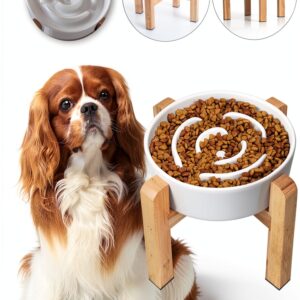
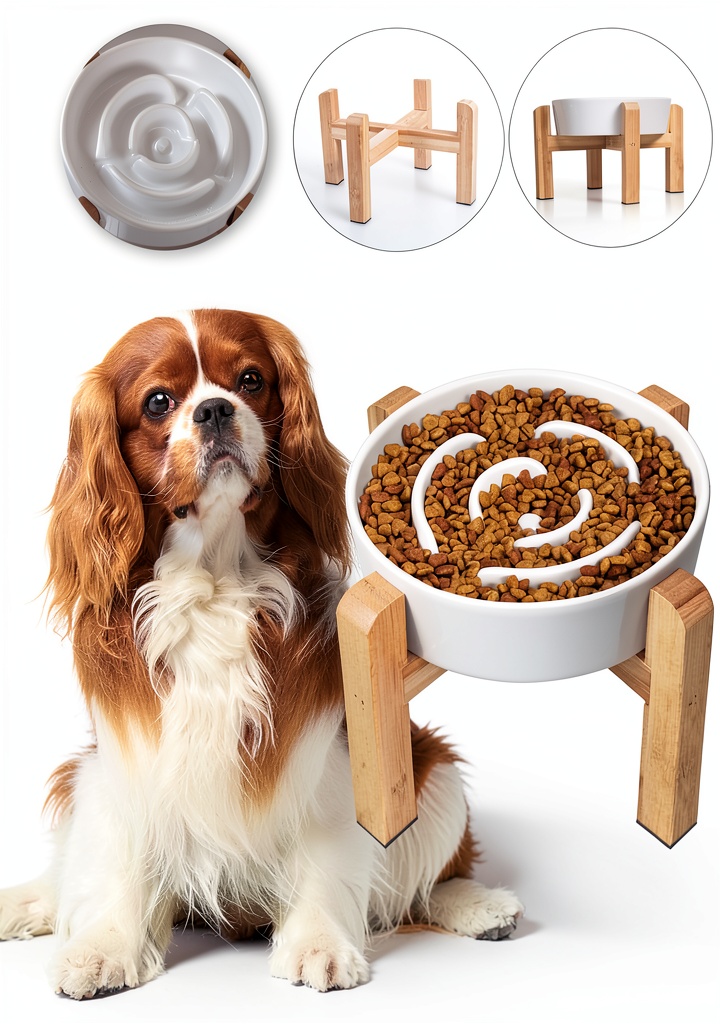
The PTOBER Dog Slow Feeder is a hybrid solution that combines two popular feeding concepts: the digestive benefits of slow feeding and the ergonomic advantages of an elevated bowl. Where it diverges from many competitors is in its material choice. Instead of the common plastic or stainless steel, it uses a glossy, food-grade ceramic for the bowl itself, mounted on a solid bamboo stand.
The design features a series of concentric ridges rather than a complex maze. This creates a gentler eating challenge that’s less likely to frustrate dogs new to slow feeders. The entire unit feels substantial in hand—the 2.38-pound weight is a sign of quality that immediately distinguishes it from flimsier options.
| Specification | Details |
|---|---|
| Material | Food-Grade Ceramic (Bowl), Natural Bamboo (Base) |
| Available Sizes | 1.25 CUP, 2.5 CUP |
| Overall Dimensions | 6.7 x 6.7 x 1.8 inches |
| Weight | 2.38 pounds |
| Key Features | Slow-feed ridges, Elevated bamboo stand, Non-slip stickers |
| Best For Dog Size | Small to Medium Breeds (up to ~50 lbs) |
Real-World Performance & Feature Analysis
Design & Build Quality: Where the Price Justifies Itself
Unboxing the PTOBER bowl, the first thing you notice is the heft. The ceramic bowl has a satisfying weight that cheap plastic feeders lack. The glaze is even and smooth, with no rough edges that could harbor bacteria. The bamboo base is equally well-finished, with rounded corners and a natural wood grain that looks attractive in a home setting.
Why this matters: A heavy, stable bowl is crucial for dogs who tend to push their food around. My Labrador tested this immediately by trying to nudge the bowl with her nose—it slid slightly but didn’t tip, thanks to the rubber stickers on the bamboo base. For context, a lightweight plastic bowl would have been halfway across the room.
The ridge design is intentional. It’s not the most complicated pattern on the market, and that’s likely by design. For a dog new to slow feeders, an overly complex maze can be so frustrating they refuse to eat. The PTOBER’s ridges create just enough obstruction to slow eating without causing anxiety.
Performance in Real Use: Two Dogs, Two Very Different Experiences
Scenario 1: The Frantic Gulper (Bailey, 4-year-old Labrador)
Bailey typically finishes her 1.5 cups of kibble in about 45 seconds flat from a regular bowl. With the PTOBER, that time increased to nearly 3 minutes. This is a significant improvement for digestion, though it’s worth noting she’s not the world’s most determined gulper. A dog with more severe issues might still power through this design. The ceramic surface also seemed to reduce the ‘snorting’ sounds she makes when eating too fast, as the smooth ridges didn’t force her to snuffle as deeply as some fabric-lined maze designs.
Scenario 2: The Methodical Eater (Charlie, 8-year-old Terrier)
Charlie has never been a fast eater, but he’s messy. Kibble constantly ended up on the floor around his old stainless steel bowl. The PTOBER’s contained design and raised edges kept 90% of the food contained. The elevation at 1.8 inches was perfect for his stature, allowing him to eat without craning his neck down. For him, the benefits were more about cleanliness and posture than slowing down.
The non-slip performance is excellent on tile and hardwood floors. The combination of the bowl’s weight and the rubber stickers on the bamboo base means normal eating activity won’t send it sliding. However, during testing, Bailey did manage to move it significantly when she was particularly excited—so if you have a very strong, determined dog, no bowl is completely immovable.
Ease of Cleaning: The Trade-Off for Better Materials
This is where you’ll notice the biggest difference from plastic slow feeders. Ceramic doesn’t absorb odors or stains, so even after wet food, a simple wash with soap and water eliminates all smells. There’s no lingering greasy feeling that plastic often retains.
The catch: Those stylish ridges need attention. While food doesn’t stick to the smooth glaze, it does get trapped in the narrow valleys between ridges. A standard sponge won’t reach everything. I found a bottle brush or a toothbrush is necessary for a truly thorough clean. If you’re the type to just quickly rinse a bowl, this will lead to built-up residue over time.
Dishwasher safety is a plus, but the bulk of the unit means it will take up a significant amount of space. Hand washing is often more practical.
Durability & Long-Term Reliability
After a month of twice-daily use and dishwasher cycles, the PTOBER bowl shows no signs of wear. The glaze is intact, the colors haven’t faded, and the bamboo shows no water damage. Ceramic is inherently durable against scratches, which is a major advantage over plastic.
The realistic limitation: Ceramic can chip or crack if dropped on a hard surface. This isn’t a bowl to use outdoors on concrete or for dogs who are known to pick up and drop their bowls. The bamboo base is also susceptible to water damage if left wet consistently. Wiping it dry after washing is a necessary habit.
Pros & Cons
Pros:
- Superior material safety: Ceramic is non-porous, non-toxic, and doesn’t harbor bacteria like plastic can.
- Effective for moderate gulpers: Successfully slows eating speed without causing frustration.
- Excellent stability: Weight and non-slip base prevent most sliding during use.
- Aesthetically pleasing: Looks more like a household item than a pet product.
- Easy to clean surface (with the right tools): No odor retention and stains wipe away easily.
Cons:
- Capacity limitations: The 2.5-cup size is realistically best for meals of 1.5 cups or less to prevent spillover.
- Not for power chewers: While durable, ceramic can break if mishandled by destructive dogs.
- Requires detailed cleaning: Ridges need a brush to clean thoroughly, adding a step to your routine.
- Moderate elevation only: Not high enough to provide meaningful joint relief for very large dogs.
Comparison & Alternatives
To understand where the PTOBER fits, it’s essential to compare it to options at different price points and with different design philosophies.
Cheaper Alternative: Outward Hound Fun Feeder (Plastic, ~$12)
This is the most popular slow feeder on the market. It uses a complex maze pattern that’s extremely effective at slowing down even the fastest eaters. However, it’s made of plastic, which can develop scratches that harbor bacteria and may retain odors over time. It’s also very lightweight and easily pushed around by enthusiastic dogs.
When to choose the Outward Hound: If your primary and only concern is slowing down a severe gulper as effectively as possible, and you’re on a tight budget.
When to stick with PTOBER: If you value material safety, ease of cleaning (odor-free), stability, and aesthetics for use in your home.
Premium Alternative: Neater Feeder Express (Stainless Steel & Plastic, ~$40+)
This elevated feeder uses a removable stainless steel insert placed inside a plastic outer frame with a lip to contain mess. The steel is the gold standard for durability and cleanliness. The elevation is also more significant, making it better for large breeds.
When to choose the Neater Feeder: If you have a giant breed needing significant elevation, or you prioritize the absolute easiest cleaning (the steel insert is seamless and simple to wipe).
When to stick with PTOBER: If you prefer a single, solid unit without removable parts, want to avoid plastic entirely, or prefer the aesthetic of ceramic and wood.
Buying Guide / Who Should Buy
Choosing a slow feeder isn’t just about the product—it’s about matching it to your dog’s specific needs and your own priorities as an owner.
Best For Beginners: If you’re new to slow feeders, the PTOBER is an excellent starting point. The ridge design is challenging enough to help without being so difficult that it discourages your dog. The materials are clearly superior to basic plastic, giving you peace of mind about safety.
Best For Experienced Owners Seeking an Upgrade: If you’ve used plastic slow feeders before and are tired of the lingering smells, staining, or flimsy feel, the PTOBER represents a meaningful upgrade in quality and daily experience.
Not Recommended For:
- Owners of giant breeds like Great Danes or Saint Bernards. The bowl capacity and low elevation won’t meet their needs.
- Households with dogs that are destructive with their bowls. While sturdy, ceramic can break if thrown or dropped aggressively.
- Anyone seeking the absolute maximum slowing effect. For the most extreme gulpers, a more complex maze design will be more effective.
- Owners who want a zero-maintenance cleaning routine. The ridges require a bit more effort than a flat stainless steel bowl.
Frequently Asked Questions
Q: Is the ceramic bowl truly chip-resistant?
A: It’s durable for normal use, but like any ceramic, it can chip or crack if dropped on a hard surface like tile or concrete. It’s not recommended for dogs who routinely flip or throw their bowls.
Q: My dog is a very picky eater. Will the ridges put him off his food?
A: The ridge design is one of the less intimidating slow-feeder patterns. However, if your dog is particularly fussy, you might initially mix a high-value treat in with the kibble to create a positive association. Most dogs adapt within a few meals.
Q: How do I clean the bamboo base?
A> Wipe it with a damp cloth. Do not submerge it in water or put it in the dishwasher, as this can cause the bamboo to warp or crack over time. The ceramic bowl itself is dishwasher safe.
Q: Is the 2.5-cup size measured to the brim or to a realistic fill line?
A> It’s measured to the brim. However, if you fill it completely, kibble will easily spill over the ridges when the dog eats. For practical use, a 1.5-cup meal fits well with room to maneuver.
Q: Is this bowl worth almost $20 when there are cheaper options?
A> This is the core value question. If you view a dog bowl as a disposable item, then no. If you view it as a long-term investment in your dog’s health and your own convenience, then yes. The material quality, stability, and aesthetics justify the price over a basic plastic model, provided it fits your dog’s size and eating style.